بين أيديكم أول 360 مرجعا من كتابي: استنطاق المنطق؛ لن أستبق الأحداث -في حين أن الكتاب استبق الأزمان- إلا أن ما فعلتُه في كتابي هذا أنني جمّعتُ المنطق وجذّرتُه مِن أصوله ثم أحكمت القبضات على فروعه ففتّتُه تفتيتا ثم بنيته كما لو أن العقول والنوابغ التي توافدت عليه قاطبةً مثَلَتْ أمامي واستجوبتها فأحلتُ ذلك الفتات جسمًا من جديد، لقد استطاع استنطاق المنطق أن يفسِّر /لـــماذا و/كـــيف، فأحسنَ البيان والبنيان ولعلي أقولها دون مواربةٍ أو كِبر: إنْ لم يكن كتابي هذا أعظمَ ما كتب في المنطق عربيًّا وإسلاميا -لا من حيث التجديد في جسم المنطق ذاته بل من حيث التجديد التحليليّ- آخرَ 300 سنة، فبلا منطق بلا بطيخ! والكتاب -حقيقةً- يصلح للقرّاء من مختلَف خلفيات الاطلاع والثقافة المنطقية. ولا يهفو أحد فيتهمني بباطلةٍ من كبر أو غرور! اصطبر ترى الكتاب منشورا وكفى.
أستخدم LaTeX في الكتابة ولذا قد تحوي بعض المصادر Formats إضافية لأنني استخرجتها على عجالة.
1. Jonathan Barnes, *The Presocratic Philosophers* (London: Routledge and Kegan Paul, 1982).
2. Plato, *Cratylus*.
3. Hermann Diels and Walther Kranz, *Die Fragmente der Vorsokratiker*, 6th ed. (Berlin: Weidmann, 1951–52).
4. G.S. Kirk, *Heraclitus: The Cosmic Fragments* (Cambridge: Cambridge University Press, 1954).
5. M. Marcovich, *Heraclitus: Greek Text with a Short Commentary* (Merida: Los Andes University Press, 1967).
6. James Warren, *Presocratics* (Stocksfield: Acumen, 2007).
7. Charles H. Kahn, *The Art and Thought of Heraclitus* (Cambridge: Cambridge University Press, 1979).
8. Aristotle, *Metaphysics*.
9. Aristotle, *Physics*.
10. Aristotle, *Prior Analytics*.
11. Aristotle, *Categories*.
12. Aristotle, *Sophistical Refutations*.
13. Karl Reinhardt, *Parmenides und die Geschichte der Griechischen Philosophie* (Bonn: Friedrich Cohen, 1916).
14. Michael V. Wedin, *Parmenides' Grand Deduction: A Logical Reconstruction of the Way of Truth* (Oxford: Oxford University Press, 2014).
15. John Burnet, *Early Greek Philosophy*, 4th ed. (London: Adam and Charles Black, 1930).
16. Plato, *Parmenides*. Translation following R.E. Allen, *Plato's Parmenides* (Minneapolis: University of Minnesota Press, 1983).
17. Carl B. Boyer, *The History of the Calculus and Its Conceptual Development* (New York: Dover, 1959).
18. Wesley Salmon, *Zeno's Paradoxes* (Indianapolis: Hackett, 2001 [1970]).
19. Kevin Davey, "Aristotle, Zeno, and the Stadium Paradox," *History of Philosophy Quarterly* 24 (2007): 127–146.
20. Barbara Apodaca Sattler, "Zeno's Stadium Paradox," in *The Routledge Handbook of Ancient Greek Philosophy* (2024).
21. Simplicius, *On Aristotle's Physics*.
22. Bertrand Russell, *Our Knowledge of the External World* (London: Allen and Unwin, 1914).
23. Bertrand Russell, *The Principles of Mathematics* (Cambridge: Cambridge University Press, 1903).
24. B. Kerferd, *The Sophistic Movement* (Cambridge: Cambridge University Press, 1981).
25. W.K.C. Guthrie, *A History of Greek Philosophy*, vol. 3 (Cambridge: Cambridge University Press, 1969).
26. Sextus Empiricus, *Adversus Mathematicos*.
27. Sextus Empiricus, *Outlines of Pyrrhonism*.
28. Edward Schiappa, *Protagoras and Logos: A Study in Greek Philosophy and Rhetoric* (Columbia: University of South Carolina Press, 2003).
29. T.M. Robinson, *Contrasting Arguments: An Edition of the Dissoi Logoi* (New York: Arno Press, 1979).
30. Pseudo-Aristotle, *De Melisso, Xenophane, Gorgia*.
31. Gorgias, *Encomium of Helen* 😊 DK 82B11).
32. Myles Burnyeat, "Protagoras and Self-Refutation in Later Greek Philosophy," *Philosophical Review* 85 (1976): 44–69.
33. Thomas Heath, *A History of Greek Mathematics*, vol. 1 (Oxford: Clarendon Press, 1921).
34. Plato, *Phaedo*.
35. Plato, *Republic*.
36. Plato, *Symposium*.
37. Gregory Vlastos, "The Third Man Argument in the Parmenides," *Philosophical Review* 63 (1954): 319–349.
38. Samuel Rickless, *Plato's Forms in Transition* (Cambridge: Cambridge University Press, 2007).
39. Francis Jeffry Pelletier and Edward N. Zalta, "How to Say Goodbye to the Third Man," *Noûs* 34 (2000): 165–202.
40. S. Marc Cohen, "The Logic of the Third Man," *Philosophical Review* 80 (1971): 448–475.
41. J.M.E. Moravcsik, "The Anatomy of Plato's Divisions," in *Exegesis and Argument: Studies in Greek Philosophy*, ed. E.N. Lee et al. (Assen: Van Gorcum, 1973), 324–348.
42. Immanuel Kant, *Critique of Pure Reason* (1781/1787). Translated by Norman Kemp Smith (London: Macmillan, 1929).
43. Norman Kretzmann, trans., *William of Sherwood's Introduction to Logic* (Minneapolis: University of Minnesota Press, 1966).
44. William Kneale and Martha Kneale, *The Development of Logic* (Oxford: Clarendon Press, 1962).
45. Jan Łukasiewicz, *Aristotle's Syllogistic from the Standpoint of Modern Formal Logic*, 2nd ed. (Oxford: Clarendon Press, 1957).
46. Manuel Correia, "Aristotle's Squares of Opposition," *South American Journal of Logic* 3, no. 2 (2017): 313–326.
47. Terence Parsons, "The Traditional Square of Opposition," *Stanford Encyclopedia of Philosophy* (2008, revised 2017).
48. George Boole, *The Mathematical Analysis of Logic* (Cambridge: Macmillan, 1847).
49. Mark G. Henninger, *Relations: Medieval Theories 1250–1325* (Oxford: Clarendon Press, 1989).
50. Gisela Striker, trans. and comm., *Aristotle: Prior Analytics, Book I* (Oxford: Clarendon Press, 2009).
51. Marko Malink, *Aristotle's Modal Syllogistic* (Cambridge, MA: Harvard University Press, 2013).
52. Robin Patterson, *Aristotle's Modal Logic: Essence and Entailment in the Organon* (Cambridge: Cambridge University Press, 1995).
53. Marko Malink, "Aristotle on One-Sided Possibility," in Max Cresswell, Edwin Mares, and Adriane Rini, eds., *Logical Modalities from Aristotle to Carnap* (Cambridge: Cambridge University Press, 2016), 29–49.
54. Storrs McCall, *Aristotle's Modal Syllogisms* (Amsterdam: North-Holland, 1963).
55. Tim Williamson, review of Malink (2013), *Notre Dame Philosophical Reviews* (2014).
56. Gerhard Gentzen, "Untersuchungen über das logische Schließen," *Mathematische Zeitschrift* 39 (1935): 176–210, 405–431. English translation in M.E. Szabo, ed., *The Collected Papers of Gerhard Gentzen* (Amsterdam: North-Holland, 1969), 68–131.
57. Greg Restall, "Substructural Logics," *Stanford Encyclopedia of Philosophy* (2000, revised 2018).
58. Sara Negri and Jan von Plato, *Structural Proof Theory* (Cambridge: Cambridge University Press, 2001).
59. Wael B. Hallaq, *Ibn Taymiyya Against the Greek Logicians* (Oxford: Clarendon Press, 1993).
60. Paul Vincent Spade, "The Logic of the Categorical: The Medieval Theory of Descent and Ascent," in Norman Kretzmann et al., eds., *The Cambridge History of Later Medieval Philosophy* (Cambridge: Cambridge University Press, 1982), 188–196.
61. E.J. Ashworth, "Medieval Theories of Supposition," in Dov M. Gabbay and John Woods, eds., *Handbook of the History of Logic*, vol. 2 (Amsterdam: Elsevier, 2008), 85–108.
62. Catarina Dutilh Novaes, *Formalizing Medieval Logical Theories* (New York: Springer, 2007).
63. Stephen Read, "Consequence," in Robert Pasnau, ed., *The Cambridge History of Medieval Philosophy* (Cambridge: Cambridge University Press, 2010), 117–127.
64. Stephen Read, "Formal and Material Consequence, Disjunctive Syllogism and Gamma," in Klaus Jacobi, ed., *Argumentationstheorie* (Leiden: Brill, 1993), 233–259.
65. Angel d'Ors, "Ex impossibili quodlibet sequitur (Jean Buridan)," in Klaus Jacobi, ed., *Argumentationstheorie* (Leiden: Brill, 1993), 195–212.
66. Catarina Dutilh Novaes, "Medieval Obligationes as a Theory of Discursive Commitment Management," *Vivarium* 49, nos. 1–3 (2011): 240–257.
67. Romuald Green, "The Logical Treatise De Obligationibus" (Ph.D. diss., Katholieke Universiteit Leuven, 1963).
68. Catarina Dutilh Novaes, "Lessons in Philosophy of Logic from Medieval Obligationes," in Catarina Dutilh Novaes and Ole Hjortland, eds., *Insolubles and Consequences* (London: College Publications, 2012), 153–168.
69. Paul Vincent Spade, "Insolubilia," in Kretzmann et al., *The Cambridge History of Later Medieval Philosophy* (1982), 246–253.
70. Stephen Read, "The Liar Paradox from John Buridan back to Thomas Bradwardine," *Vivarium* 40, no. 2 (2002): 189–218.
71. Susanne Bobzien, "Stoic Logic," in Brad Inwood, ed., *The Cambridge Companion to the Stoics* (Cambridge: Cambridge University Press, 2003), 85–123.
72. Dimitri Gutas, *Greek Thought, Arabic Culture: The Graeco-Arabic Translation Movement in Baghdad and Early 'Abbāsid Society* (London: Routledge, 1998).
73. Nicholas Rescher, "Logic in the Islamic World," in *Encyclopedia of the History of Arabic Science*, ed. Roshdi Rashed (London: Routledge, 1996), vol. 3.
74. Tony Street, "Arabic and Islamic Philosophy of Language and Logic," *Stanford Encyclopedia of Philosophy* (2008, revised 2015).
75. Joep Lameer, *Al-Fārābī and Aristotelian Syllogistics: Greek Theory and Islamic Practice* (Leiden: Brill, 1994).
76. F.W. Zimmermann, introduction to al-Fārābī, *Commentary and Short Treatise on Aristotle's De Interpretatione* (London: Oxford University Press, 1981).
77. Simo Knuuttila, "Medieval Modal Theories and Modal Logic," in Gabbay and Woods, eds., *Handbook of the History of Logic*, vol. 2 (2008), 505–578.
78. Charles Burnett, "The Translation of Arabic Works on Logic into Latin in the Middle Ages and the Renaissance," in Gabbay and Woods, eds., *Handbook of the History of Logic*, vol. 2 (2008), 597–606.
79. John Marenbon, *Boethius* (Oxford: Oxford University Press, 2003).
80. L.M. de Rijk, *Logica Modernorum: A Contribution to the History of Early Terminist Logic*, 2 vols. (Assen: Van Gorcum, 1962–67).
81. Alain de Libera, "The Oxford and Paris Traditions in Logic," in Kretzmann et al., *The Cambridge History of Later Medieval Philosophy* (1982), 147–187.
82. Susanne Bobzien, "Chrysippus' Theory of Causes," in *Topics in Stoic Philosophy*, ed. Katerina Ierodiakonou (Oxford: Clarendon Press, 1999), 196–242.
83. Diogenes Laertius, *Lives of the Eminent Philosophers*.
84. Hans von Arnim, *Stoicorum Veterum Fragmenta*, 4 vols. (Leipzig: Teubner, 1903–24).
85. Benson Mates, *Stoic Logic* (Berkeley: University of California Press, 1953).
86. Susanne Bobzien, "Chrysippus and the Epistemic Theory of Vagueness," *Proceedings of the Aristotelian Society* 102 (2002): 217–238.
87. Susanne Bobzien, "Ancient Logic," *Stanford Encyclopedia of Philosophy*.
88. Gottlob Frege, "Über Sinn und Bedeutung," *Zeitschrift für Philosophie und philosophische Kritik* 100 (1892): 25–50. English: "On Sense and Reference," in *Translations from the Philosophical Writings of Gottlob Frege*, ed. P. Geach and M. Black (Oxford: Blackwell, 1952), 56–78.
89. Victor Caston, "Something and Nothing: The Stoics on Concepts and Universals," *Oxford Studies in Ancient Philosophy* 17 (1999): 145–213.
90. Jacques Brunschwig, "Stoic Metaphysics," in *The Cambridge Companion to the Stoics*, 206–232.
91. A. A. Long and D. N. Sedley, *The Hellenistic Philosophers*, 2 vols. (Cambridge: Cambridge University Press, 1987).
92. Michael Frede, *Die stoische Logik* (Göttingen: Vandenhoeck & Ruprecht, 1974).
93. C.I. Lewis, *A Survey of Symbolic Logic* (Berkeley, 1918).
94. Robert O'Toole and Raymond Jennings, "The Megarians and the Stoics," in *Handbook of the History of Logic*, vol. 1, ed. Gabbay and Woods (Amsterdam: Elsevier, 2004), 397–522.
95. Josiah Gould, "Chrysippus: On the Criteria for the Truth of a Conditional Proposition," *Phronesis* 12 (1967): 152–161.
96. Miguel López-Astorga, "The First Rule of Stoic Logic and Its Relationship with the Indemonstrables," *Tópicos* 50 (2016): 9–28.
97. David Sedley, "Diodorus Cronus and Hellenistic Philosophy," *Proceedings of the Cambridge Philological Society* 203 (NS 23) (1977): 74–120.
98. Richard Gaskin, *The Sea-Battle and the Master Argument* (Berlin: de Gruyter, 1995).
99. Nicholas Denyer, "The Master Argument of Diodorus Cronus: A Near Miss," *Logical Analysis and History of Philosophy* 2 (1999): 239–252.
100. Susanne Bobzien, "Chrysippus' Modal Logic and Its Relation to Philo and Diodorus," in *Dialektiker und Stoiker*, ed. K. Döring and T. Ebert (Stuttgart: Franz Steiner, 1993), 63–84.
101. R. A. Bull, "An Algebraic Study of Diodorean Modal Systems," *Journal of Symbolic Logic* 30 (1965): 58–64.
102. Richard Sorabji, ed., *Aristotle Transformed: The Ancient Commentators and Their Influence* (London: Duckworth, 1990).
103. Tony Street, "Arabic Logic," in *Handbook of the History of Logic*, vol. 1, ed. Gabbay and Woods (Amsterdam: Elsevier, 2004), pp. 523–596.
104. L. D. Reynolds and N. G. Wilson, *Scribes and Scholars: A Guide to the Transmission of Greek and Latin Literature*, 4th ed. (Oxford: Oxford University Press, 2013).
105. Jan Łukasiewicz, "Zur Geschichte der Aussagenlogik," *Erkenntnis* 5 (1935): 111–131. English: "On the History of the Logic of Propositions," in *Selected Works*, ed. L. Borkowski (Amsterdam: North-Holland, 1970), 197–217.
106. Al-Fārābī, *Iḥṣā' al-'Ulūm* (Enumeration of the Sciences), ed. 'Uthmān Amīn (Cairo: Anglo Library, 3rd ed., 1968).
107. Deborah L. Black, *Logic and Aristotle's 'Rhetoric' and 'Poetics' in Medieval Arabic Philosophy* (Leiden: Brill, 1990).
108. Shukri B. Abed, *Aristotelian Logic and the Arabic Language in Alfārābī* (Albany: SUNY Press, 1991).
109. Tony Street, "Avicenna and Tusi on the Contradiction and Conversion of the Absolute," *History and Philosophy of Logic* 21 (2000): 45–56.
110. Paul Thom, *Medieval Modal Systems* (Aldershot: Ashgate, 2003).
111. Wilfrid Hodges, "Ibn Sīnā on Modes," in *Gedankenexperimente: Wissenschaft und Philosophie*, ed. S. Rahman, T. Street, and H. Tahiri (Dordrecht: Springer, 2008), pp. 361–376.
112. Khaled El-Rouayheb, *The Development of Arabic Logic (1200–1800)* (Basel: Schwabe, 2019).
113. Frank Griffel, *Al-Ghazālī's Philosophical Theology* (Oxford: OUP, 2009).
114. Frank Griffel, "Al-Ghazālī's Use of 'Original Human Disposition' (fitra) and Its Background in the Teachings of al-Fārābī and Avicenna," *Muslim World* 102 (2012): 1–32.
115. E. J. Ashworth, "Terminist Logic," in *The Cambridge History of Later Medieval Philosophy*, ed. N. Kretzmann, A. Kenny, and J. Pinborg (Cambridge: CUP, 1982), pp. 147–187.
116. William of Ockham, *Summa Logicae*.
117. John Buridan, *Summulae de Dialectica*, trans. Gyula Klima (New Haven: Yale UP, 2001).
118. Peter of Spain, *Tractatus*, ed. L. M. de Rijk (Assen: van Gorcum, 1972).
119. J. Salamucha, "The Propositional Logic of William of Ockham" (1935).
120. Claude Panaccio, "Semantics and Mental Language," in *The Cambridge Companion to Ockham*, ed. P. V. Spade (Cambridge: CUP, 1999), pp. 53–75.
121. Catarina Dutilh Novaes and Sara Uckelman, "Obligationes," in *The Cambridge Companion to Medieval Logic*, ed. C. Dutilh Novaes and S. Read (Cambridge: CUP, 2016), pp. 370–395.
122. Henrik Lagerlund and Erik Olsson, "Disputation and Change of Belief — Burley's Theory of Obligationes as a Theory of Belief Revision," in *Medieval Formal Logic*, ed. Mikko Yrjönsuuri (Dordrecht: Kluwer, 2001), pp. 35–62.
123. Catarina Dutilh Novaes, "Medieval Obligationes as Logical Games of Consistency Maintenance," *Synthese* 145 (2005): 371–395.
124. Thomas Bradwardine, *Insolubilia*, ed. and trans. Stephen Read, Dallas Medieval Texts and Translations 10 (Leuven: Peeters, 2010).
125. Gyula Klima, "Logic without Truth: Buridan on the Liar," in *Unity, Truth and the Liar*, ed. S. Rahman, T. Tulenheimo, and E. Genot (Berlin: Springer, 2008), pp. 87–112.
126. Piotr Łukowski and Bartosz Żukowski, "Psychophysiological Approach to the Liar Paradox: Jean Buridan's Virtual Entailment Principle Put to the Test," *Synthese* 198 (2021): 1041–1055.
127. Catarina Dutilh Novaes, "Lessons on Truth from Mediaeval Solutions to the Liar Paradox," *The Philosophical Quarterly* 61 (2011): 58–78.
128. Alfred Tarski, "The Concept of Truth in Formalized Languages" (1935), in *Logic, Semantics, Metamathematics*, trans. J. H. Woodger (Oxford: Clarendon Press, 1956), pp. 152–278.
129. Richard M. Frank, *Beings and Their Attributes: The Teaching of the Basrian School of the Mu'tazila* (Albany: SUNY Press, 1978).
130. Robert Wisnovsky, *Avicenna's Metaphysics in Context* (Ithaca: Cornell UP, 2003).
131. Edward Grant, "The Condemnation of 1277, God's Absolute Power, and Physical Thought in the Late Middle Ages," *Viator* 10 (1979): 211–244.
132. Simo Knuuttila, "Modal Logic," in *Cambridge History of Later Medieval Philosophy*, pp. 342–357.
133. Simo Knuuttila, *Modalities in Medieval Philosophy* (London: Routledge, 1993).
134. John F. Sowa, "Analogical Reasoning," in *Conceptual Structures for Knowledge Creation and Communication*, Lecture Notes in AI 2746 (Berlin: Springer, 2003).
135. Henrik Lagerlund, *Modal Syllogistics in the Middle Ages* (Leiden: Brill, 2000).
136. Khaled El-Rouayheb, *Relational Syllogisms and the History of Arabic Logic, 900–1900* (Leiden: Brill, 2010).
137. C. I. Gerhardt (ed.), *Die philosophischen Schriften von Gottfried Wilhelm Leibniz*, 7 vols. (Berlin, 1875–1890).
138. Marcelo Dascal, "Leibniz's Two-Pronged Dialectic," in *Leibniz: What Kind of Rationalist?*, ed. M. Dascal (Dordrecht: Springer, 2008), 37–72.
139. Jean van Heijenoort, "Logic as Calculus and Logic as Language," *Synthese* 17 (1967): 324–330.
140. Volker Peckhaus, "Calculus ratiocinator versus characteristica universalis? The Two Traditions in Logic, Revisited," *History and Philosophy of Logic* 25 (2004): 3–14.
141. Massimo Mugnai and Han van Ruler (eds.), *Leibniz: Dissertation on Combinatorial Art* (Oxford: Oxford University Press, 2020).
142. Thomas Hobbes, *De Corpore* (1655).
143. Ferdinand Tönnies, "Leibniz und Hobbes," *Philosophische Monatshefte* 23 (1887): 557–573.
144. Anthony Bonner, *The Art and Logic of Ramon Llull* (Leiden: Brill, 2007).
145. Hidé Ishiguro, *Leibniz's Philosophy of Logic and Language* (London: Duckworth, 1972).
146. Nicholas Rescher, "Leibniz's Interpretation of His Logical Calculi," *Journal of Symbolic Logic* 19 (1954): 1–13.
147. Vladimir Sotirov, "Arithmetizations of Syllogistic à la Leibniz," *Journal of Applied Non-Classical Logics* 9 (1999): 387–405.
148. Wolfgang Lenzen, "Leibniz's Logic," in *The Handbook of the History of Logic*, vol. 3, ed. Dov Gabbay and John Woods (Amsterdam: Elsevier, 2004), 1–83.
149. Wolfgang Lenzen, *Das System der Leibnizschen Logik* (Berlin: de Gruyter, 1990).
150. Chris Swoyer, "Leibniz's Calculus of Real Addition," *Studia Leibnitiana* 26 (1994): 1–30.
151. Hector-Neri Castañeda, "Leibniz's Syllogistico-Propositional Calculus," *Notre Dame Journal of Formal Logic* 17 (1976): 481–500.
152. Marko Malink and Anubav Vasudevan, "The Logic of Leibniz's Generales Inquisitiones de Analysi Notionum et Veritatum," *Review of Symbolic Logic* 9 (2016): 686–751.
153. Hector-Neri Castañeda, "Leibniz's Complete Propositional Logic," *Topoi* 9 (1990): 15–28.
154. Louis Couturat, *La Logique de Leibniz* (Paris: Félix Alcan, 1901).
155. Massimo Mugnai, "Leibniz e la logica," *Matematica, Cultura e Società: Rivista dell'Unione Matematica Italiana* 1.3 (2016): 241–257.
156. Jean Marguin, *Histoire des instruments et machines à calculer* (Paris: Hermann, 1994).
157. Michael R. Williams, *A History of Computing Technology*, 2nd ed. (Los Alamitos, CA: IEEE Computer Society Press, 1997).
158. Erwin Stein, "The Leibniz Calculating Machine and the Stepped Drum," in Heinz Nixdorf MuseumsForum (ed.), *Calculating a Goddess: Leibniz's Calculator* (Paderborn, 2016), 12–34.
159. Stan Augarten, *Bit by Bit: An Illustrated History of Computers* (New York: Ticknor & Fields, 1984).
160. Leibniz, "Explication de l'Arithmétique Binaire," *Mémoires de l'Académie Royale des Sciences* (Paris, 1703). Translation in Lloyd Strickland and Harry R. Lewis, *Leibniz on Binary: The Invention of Computer Arithmetic* (Cambridge, MA: MIT Press, 2022).
161. Franklin Perkins, *Leibniz and China: A Commerce of Light* (Cambridge: Cambridge University Press, 2004).
162. R. M. Swiderski, "Bouvet and Leibniz: A Scholarly Correspondence," *Eighteenth-Century Studies* 14 (1980): 135–150.
163. Umberto Eco, *The Search for the Perfect Language*, trans. James Fentress (Oxford: Blackwell, 1995).
164. James Gleick, *The Information: A History, A Theory, A Flood* (New York: Pantheon, 2011).
165. Norbert Wiener, *Cybernetics: or Control and Communication in the Animal and the Machine*, 2nd ed. (Cambridge, MA: MIT Press, 1961).
166. Volker Peckhaus, *Logik, Mathesis universalis und allgemeine Wissenschaft* (Berlin: Akademie Verlag, 1997).
167. I. Grattan-Guinness, *The Search for Mathematical Roots, 1870–1940* (Princeton: Princeton University Press, 2000).
168. Otto Bradley Bassler, "Leibniz on Intension, Extension, and the Representation of Syllogistic Inference," *Synthese* 116 (1998): 117–139.
169. Benson Mates, *The Philosophy of Leibniz: Metaphysics and Language* (New York: Oxford University Press, 1986).
170. Martin Davis, *The Universal Computer: The Road from Leibniz to Turing* (New York: W. W. Norton, 2000).
171. Nicholas Jolley, "Russell on Leibniz," in *The Cambridge Companion to Bertrand Russell*, ed. Nicholas Griffin (Cambridge: Cambridge University Press, 2003), 19–45.
172. Gottlob Frege, *Begriffsschrift, eine der arithmetischen nachgebildete Formelsprache des reinen Denkens* (Halle: L. Nebert, 1879).
173. Gottfried Gabriel, "Frege, Lotze, and the Continental Roots of Early Analytic Philosophy," in *From Frege to Wittgenstein*, ed. Erich H. Reck (Oxford: Oxford University Press, 2002), 39–51.
174. Ivor Grattan-Guinness, "Living Together and Living Apart: On the Interactions between Mathematics and Logics from the French Revolution to the First World War," *South African Journal of Philosophy* 7 (1988): 73–82.
175. Ivor Grattan-Guinness, "The Correspondence between George Boole and Stanley Jevons, 1863–1864," *History and Philosophy of Logic* 12 (1991): 15–35.
176. Stanley Burris, "The Algebra of Logic Tradition," *Stanford Encyclopedia of Philosophy* (2009, revised 2015).
177. George Peacock, *A Treatise on Algebra*, 2 vols., 2nd ed. (Cambridge: Cambridge University Press, 1842–1845).
178. Helena M. Pycior, "George Peacock and the British Origins of Symbolical Algebra," *Historia Mathematica* 8 (1981): 23–45.
179. Sloan Evans Despeaux, "Symbolical Algebra as a Foundation for Calculus: D. F. Gregory's Contribution," *Historia Mathematica* 30 (2003): 140–163.
180. Duncan F. Gregory, "On the Solution of Linear Differential Equations with Constant Coefficients," *Cambridge Mathematical Journal* 1 (1839): 22–32.
181. George Boole, "On the Integration of Linear Differential Equations with Constant Coefficients," *Cambridge Mathematical Journal* 2 (1841): 114–119.
182. Desmond MacHale, *The Life and Work of George Boole* (Cork: Cork University Press, 1985).
183. Stanley Burris, "George Boole," *Stanford Encyclopedia of Philosophy* (2009, revised 2024).
184. Augustus De Morgan, "On the Foundation of Algebra," *Transactions of the Cambridge Philosophical Society* 7 (1839): 173–187.
185. Peter Heath, "Editor's Introduction," in Augustus De Morgan, *On the Syllogism and Other Logical Writings*, ed. Peter Heath (London: Routledge & Kegan Paul, 1966).
186. Luis María Laita, "Influences on Boole's Logic: The Controversy between William Hamilton and Augustus De Morgan," *Annals of Science* 36 (1979): 45–65.
187. Volker Peckhaus, *Quantifikation des Prädikats und numerisch definiter Syllogismus* (Münster: mentis, 2015).
188. George Boole, *An Investigation of the Laws of Thought on Which Are Founded the Mathematical Theories of Logic and Probabilities* (London: Walton and Maberly, 1854).
189. Theodore Hailperin, *Boole's Logic and Probability*, 2nd ed. (Amsterdam: North-Holland, 1986).
190. John Corcoran, "Aristotle's Prior Analytics and Boole's Laws of Thought," *History and Philosophy of Logic* 24 (2003): 261–288.
191. Daniel D. Merrill, *Augustus De Morgan and the Logic of Relations* (Dordrecht: Kluwer, 1990).
192. Augustus De Morgan, "On the Syllogism, No. IV, and on the Logic of Relations," *Transactions of the Cambridge Philosophical Society* 10 (1860): 331–358.
193. Geraldine Brady, *From Peirce to Skolem: A Neglected Chapter in the History of Logic* (Amsterdam: North-Holland, 2000).
194. Benjamin S. Hawkins Jr., "De Morgan, Victorian Syllogistic and Relational Logic," *Modern Logic* 5 (1995): 131–166.
195. Augustus De Morgan, *Formal Logic* (London: Taylor and Walton, 1847).
196. Paul Halmos, *Lectures on Boolean Algebras* (Princeton: Van Nostrand, 1963).
197. Walter Isaacson, *The Innovators* (New York: Simon & Schuster, 2014).
198. N. J. A. Sloane and A. D. Wyner (eds.), *Claude Elwood Shannon: Collected Papers* (New York: IEEE Press, 1993).
199. Claude E. Shannon, "A Symbolic Analysis of Relay and Switching Circuits," *Transactions of the American Institute of Electrical Engineers* 57 (1938): 713–723.
200. Herman H. Goldstine, *The Computer from Pascal to von Neumann* (Princeton: Princeton University Press, 1972).
201. J. Donald Monk, "Introduction to Boolean Algebras," lecture notes (2009).
202. Volker Peckhaus, "Psychologism and the Distinction between Discovery and Justification," in *Psychologism: The Sociology of Philosophical Knowledge*, ed. Martin Kusch (London: Routledge, 1995), pp. 99–116.
203. Willard Van Orman Quine, *Methods of Logic*, 4th ed. (Cambridge, MA: Harvard University Press, 1982).
204. William Stanley Jevons, *Pure Logic* (London: Edward Stanford, 1864).
205. W. Mays, "Jevons's Conception of Scientific Method," *The Manchester School* 30 (1962): 223–249.
206. Charles Sanders Peirce, "On the Algebra of Logic," *American Journal of Mathematics* 3 (1880): 15–57.
207. Ernst Schröder, *Vorlesungen über die Algebra der Logik*, 3 vols. (Leipzig: Teubner, 1890–1905).
208. Don D. Roberts, *The Existential Graphs of Charles S. Peirce* (The Hague: Mouton, 1973).
209. J. Jay Zeman, *The Graphical Logic of C. S. Peirce* (PhD diss., University of Chicago, 1964).
210. Ahti-Veikko Pietarinen, "Existential Graphs as an Instrument of Logical Analysis: Part I. Alpha," *The Review of Symbolic Logic* 9 (2016): 209–237.
211. John F. Sowa, *Conceptual Structures: Information Processing in Mind and Machine* (Reading, MA: Addison-Wesley, 1984).
212. T. W. Bynum, "Editor's Introduction," in Frege, *Conceptual Notation and Related Articles*, trans. T. W. Bynum (Oxford: Clarendon Press, 1972).
213. Jean van Heijenoort, ed., *From Frege to Gödel: A Source Book in Mathematical Logic, 1879–1931* (Cambridge, MA: Harvard University Press, 1967).
214. Michael Dummett, *Frege: Philosophy of Language*, 2nd ed. (London: Duckworth, 1981).
215. Lothar Kreiser, *Gottlob Frege: Leben, Werk, Zeit* (Hamburg: Felix Meiner, 2001).
216. Rudolf Carnap, "Intellectual Autobiography," in *The Philosophy of Rudolf Carnap*, ed. P. A. Schilpp (La Salle, IL: Open Court, 1963), pp. 3–84.
217. George Berkeley, *The Analyst* (1734).
218. Judith V. Grabiner, *The Origins of Cauchy's Rigorous Calculus* (Cambridge, MA: MIT Press, 1981).
219. Umberto Bottazzini, *The Higher Calculus* (New York: Springer, 1986).
220. Richard Dedekind, *Stetigkeit und irrationale Zahlen* (Braunschweig: Vieweg, 1872).
221. Georg Cantor, "Über die Ausdehnung eines Satzes aus der Theorie der trigonometrischen Reihen," *Mathematische Annalen* 5 (1872): 123–132.
222. John Stuart Mill, *A System of Logic* (London: Longmans, 1843).
223. Gottlob Frege, *Die Grundlagen der Arithmetik* (Breslau: Koebner, 1884). English: *The Foundations of Arithmetic*, trans. J. L. Austin, 2nd rev. ed. (Oxford: Blackwell, 1953).
224. Michael Dummett, *Frege: Philosophy of Mathematics* (London: Duckworth, 1991).
225. Joan Bertran-San Millán, "Lingua Characterica and Calculus Ratiocinator," *The Review of Symbolic Logic* 14 (2021): 411–446.
226. Gottlob Frege, "Funktion und Begriff" (1891), in *The Frege Reader*, ed. Michael Beaney (Oxford: Blackwell, 1997), pp. 130–148.
227. Jeff Speaks, "Frege's Begriffsschrift," course notes, University of Notre Dame.
228. George Boolos, "Reading the Begriffsschrift," *Mind* 94 (1985): 331–344.
229. Patricia Blanchette, *Frege's Conception of Logic* (Oxford: Oxford University Press, 2012).
230. Jan Łukasiewicz, "On the History of the Logic of Propositions" (1934), in Storrs McCall, ed., *Polish Logic 1920–1939* (Oxford: Clarendon Press, 1967), pp. 66–87.
231. Dirk Schlimm, "On Frege's Begriffsschrift Notation for Propositional Logic," *History and Philosophy of Logic* 39 (2018): 112–128.
232. Crispin Wright, *Frege's Conception of Numbers as Objects* (Aberdeen: Aberdeen University Press, 1983).
233. Gottlob Frege, *Grundgesetze der Arithmetik*, 2 vols. (Jena: Pohle, 1893, 1903). English: *Basic Laws of Arithmetic*, trans. Philip A. Ebert and Marcus Rossberg (Oxford: Oxford University Press, 2013).
234. Richard G. Heck Jr., *Frege's Theorem* (Oxford: Clarendon Press, 2011).
235. Tyler Burge, *Truth, Thought, Reason: Essays on Frege* (Oxford: Clarendon Press, 2005).
236. Michael Dummett, *Origins of Analytical Philosophy* (London: Duckworth, 1993).
237. Hans Sluga, *Gottlob Frege* (London: Routledge, 1980).
238. Ernst Schröder, review of *Begriffsschrift*, *Zeitschrift für Mathematik und Physik* 25 (1880), Historisch-literarische Abtheilung, pp. 81–94.
239. J. N. Mohanty, *Husserl and Frege* (Bloomington: Indiana University Press, 1982).
240. Bertrand Russell, *My Philosophical Development* (London: Allen & Unwin, 1959).
241. Bob Hale and Crispin Wright, *The Reason's Proper Study* (Oxford: Clarendon Press, 2001).
242. Ludwig Wittgenstein, *Tractatus Logico-Philosophicus* (1921).
243. Bertrand Russell, *The Autobiography of Bertrand Russell*, 3 vols. (Boston: Little, Brown, 1967–1969).
244. A. Kanamori, "The Mathematical Import of Zermelo's Well-Ordering Theorem," *Bulletin of Symbolic Logic* 3 (1997): 281–311.
245. Irving Copi, "The Burali-Forti Paradox," *Philosophy of Science* 25, no. 4 (1958): 281–286.
246. Christopher Menzel, "Cantor and the Burali-Forti Paradox," *The Monist* 67, no. 1 (1984): 92–107.
247. Bertrand Russell, "Les paradoxes de la logique," *Revue de Métaphysique et de Morale* 14 (1906): 627–650.
248. Jules Richard, "Les principes des mathématiques et le problème des ensembles," *Revue Générale des Sciences Pures et Appliquées* 16 (1905): 541.
249. Bertrand Russell, "Mathematical Logic as Based on the Theory of Types," *American Journal of Mathematics* 30 (1908): 222–262.
250. Frank P. Ramsey, "The Foundations of Mathematics," *Proceedings of the London Mathematical Society*, ser. 2, vol. 25 (1925): 338–384.
251. Gottlob Frege, *The Basic Laws of Arithmetic*, trans. Montgomery Furth (Berkeley: University of California Press, 1964).
252. Robert May and Kai Wehmeier, "The Proof of Frege's Grundgesetze, Theorem 32," *Review of Symbolic Logic*, forthcoming.
253. W.V.O. Quine, "On Frege's Way Out," *Mind* 64, no. 254 (1955): 145–159.
254. Robert C. Landini, "New Evidence Concerning Russell's Substitutional Theory of Classes," *Russell* 9 (1989): 26–42.
255. Henri Poincaré, "Les mathématiques et la logique," *Revue de Métaphysique et de Morale* 14 (1906): 294–317.
256. Alonzo Church, "A Formulation of the Simple Theory of Types," *Journal of Symbolic Logic* 5, no. 2 (1940): 56–68.
257. Ernst Zermelo, "Untersuchungen über die Grundlagen der Mengenlehre, I," *Mathematische Annalen* 65 (1908): 261–281.
258. George Boolos, "The Iterative Conception of Set," *Journal of Philosophy* 68, no. 8 (1971): 215–231.
259. Abraham Fraenkel, "Zu den Grundlagen der Cantor-Zermeloschen Mengenlehre," *Mathematische Annalen* 86 (1922): 230–237.
260. Thoralf Skolem, "Einige Bemerkungen zur axiomatischen Begründung der Mengenlehre" (Helsinki, 1923), pp. 217–232.
261. L. E. J. Brouwer, "Intuitionism and Formalism," *Bulletin of the American Mathematical Society* 20 (1913): 81–96.
262. David Hilbert, "Über das Unendliche," *Mathematische Annalen* 95 (1926): 161–190.
263. Michael Hallett, *Cantorian Set Theory and Limitation of Size* (Oxford: Clarendon Press, 1984).
264. Alfred North Whitehead and Bertrand Russell, *Principia Mathematica*, 3 vols. (Cambridge: Cambridge University Press, 1910–1913; 2nd ed. 1925–1927).
265. Bertrand Russell, *Introduction to Mathematical Philosophy* (London: Allen & Unwin, 1919).
266. P. M. S. Hacker, *Insight and Illusion* (Oxford: Clarendon Press, 1986).
267. L. E. J. Brouwer, *Over de Grondslagen der Wiskunde* [On the Foundations of Mathematics] (doctoral dissertation, 1907).
268. A. O. Gelfond, "Sur le septième problème de Hilbert," *Izvestia Akademii Nauk SSSR* 7 (1934): 623–630.
269. L. E. J. Brouwer, "Intuitionistic Reflections on Formalism" (1927), in Paolo Mancosu (ed.), *From Brouwer to Hilbert* (Oxford: Oxford University Press, 1998).
270. Michael Dummett, *Elements of Intuitionism*, 2nd ed. (Oxford: Oxford University Press, 2000).
271. L. E. J. Brouwer, "De onbetrouwbaarheid der logische principes," *Tijdschrift voor Wijsbegeerte* 2 (1908): 152–158.
272. Hermann Weyl, "Über die neue Grundlagenkrise der Mathematik," *Mathematische Zeitschrift* 10 (1921): 39–79.
273. Hermann Weyl, *Philosophy of Mathematics and Natural Science* (Princeton: Princeton University Press, 1949).
274. David Hilbert, *Grundlagen der Geometrie* (Leipzig: Teubner, 1899). English: *Foundations of Geometry*, trans. E. J. Townsend (Chicago: Open Court, 1902).
275. David Hilbert, "Neubegründung der Mathematik" (1922), in Mancosu (ed.), *From Brouwer to Hilbert* (1998).
276. Michael Detlefsen, *Hilbert's Program: An Essay on Mathematical Instrumentalism* (Dordrecht: Reidel, 1986).
277. Wilfried Sieg, *Hilbert's Programs and Beyond* (Oxford: Oxford University Press, 2013).
278. Paul Bernays, "Hilbert's Significance for the Philosophy of Mathematics" (1922), in Mancosu (ed.), *From Brouwer to Hilbert* (1998), pp. 189–197.
279. Richard Zach, "Hilbert's Program Then and Now," in Dale Jacquette (ed.), *Philosophy of Logic* (Amsterdam: Elsevier, 2007), pp. 411–447.
280. Jeremy Avigad and Richard Zach, "The Epsilon Calculus," *Stanford Encyclopedia of Philosophy* (2020).
281. John W. Dawson, *Logical Dilemmas: The Life and Work of Kurt Gödel* (Wellesley, MA: A. K. Peters, 1997).
282. W. V. O. Quine, "Truth by Convention" (1936), in *The Ways of Paradox* (New York: Random House, 1966), pp. 77–106.
283. Charles S. Chihara, *Ontology and the Vicious-Circle Principle* (Ithaca: Cornell University Press, 1973).
284. Paul Bernays, "On Platonism in Mathematics" (1935), in Paul Benacerraf and Hilary Putnam (eds.), *Philosophy of Mathematics: Selected Readings*, 2nd ed. (Cambridge: Cambridge University Press, 1983), pp. 258–271.
285. Arend Heyting, "Die formalen Regeln der intuitionistischen Logik," *Sitzungsberichte der Preussischen Akademie der Wissenschaften* (1930): 42–56.
286. Stewart Shapiro, *Philosophy of Mathematics: Structure and Ontology* (Oxford: Oxford University Press, 1997).
287. Hermann Weyl, "Die heutige Erkenntnislage in der Mathematik" (1925), in Mancosu (ed.), *From Brouwer to Hilbert* (1998).
288. Abraham Pais, *"Subtle Is the Lord": The Science and the Life of Albert Einstein* (Oxford: Oxford University Press, 1982).
289. Dirk van Dalen, *Mystic, Geometer, and Intuitionist: The Life of L. E. J. Brouwer*, 2 vols. (Oxford: Clarendon Press, 1999–2005).
290. Kurt Gödel, "Über formal unentscheidbare Sätze der Principia Mathematica und verwandter Systeme I," *Monatshefte für Mathematik und Physik* 38 (1931): 173–198.
291. Panu Raatikainen, "Gödel's Incompleteness Theorems," *Stanford Encyclopedia of Philosophy* (2021).
292. Ian Hacking, "What Is Logic?" *Journal of Philosophy* 76 (1979): 285–319.
293. Ray Monk, *Bertrand Russell: The Spirit of Solitude*, vol. 1 (New York: Free Press, 1996).
294. Gregory Landini, *Russell's Hidden Substitutional Theory* (Oxford: Oxford University Press, 1998).
295. Stephen Wolfram, "100 Years Since Principia Mathematica," stephenwolfram.com (2010).
296. Graham Priest, *Beyond the Limits of Thought* (Cambridge: Cambridge University Press, 1995).
297. Hermann Weyl, *Das Kontinuum* (Leipzig: Veit, 1918).
298. Fairouz Kamareddine, Twan Laan, and Rob Nederpelt, *A Modern Perspective on Type Theory* (Dordrecht: Kluwer, 2004).
299. A. D. Irvine and Harry Godwyn, "Principia Mathematica," *Stanford Encyclopedia of Philosophy* (2019).
300. G. H. Hardy, *A Mathematician's Apology* (Cambridge: Cambridge University Press, 1940).
301. William Ewald and Wilfried Sieg (eds.), *David Hilbert's Lectures on the Foundations of Arithmetic and Logic 1917–1933* (Berlin: Springer, 2013).
302. Gregory H. Moore, *Zermelo's Axiom of Choice* (New York: Springer, 1982).
303. Kurt Gödel, "Russell's Mathematical Logic," in P. A. Schilpp (ed.), *The Philosophy of Bertrand Russell* (Evanston: Northwestern University Press, 1944).
304. Richard Zach, "Hilbert's Program," *Stanford Encyclopedia of Philosophy* (2019, revised 2023).
305. Peter Smith, *An Introduction to Gödel's Theorems*, 2nd ed. (Cambridge: Cambridge University Press, 2013).
306. Martin Davis (ed.), *The Undecidable* (Hewlett, NY: Raven Press, 1965).
307. W. V. O. Quine, "Two Dogmas of Empiricism," *Philosophical Review* 60 (1951): 20–43.
308. Martin Davis, *Engines of Logic: Mathematicians and the Origin of the Computer* (New York: W. W. Norton, 2000).
309. Constance Reid, *Hilbert* (New York: Springer, 1970).
310. Kurt Gödel, *Collected Works*, 5 vols., ed. Solomon Feferman et al. (Oxford: Oxford University Press, 1986–2003).
311. Torkel Franzén, *Gödel's Theorem: An Incomplete Guide to Its Use and Abuse* (Wellesley, MA: A. K. Peters, 2005).
312. David Hilbert and Paul Bernays, *Grundlagen der Mathematik*, 2 vols. (Berlin: Springer, 1934–1939).
313. David Hilbert and Wilhelm Ackermann, *Grundzüge der theoretischen Logik* (Berlin: Springer, 1928).
314. Kurt Gödel, "Die Vollständigkeit der Axiome des logischen Funktionenkalküls," *Monatshefte für Mathematik und Physik* 37 (1930): 349–360.
315. Ernest Nagel and James R. Newman, *Gödel's Proof* (New York: New York University Press, 1958; revised 2001).
316. Alfred Tarski, Andrzej Mostowski, and Raphael M. Robinson, *Undecidable Theories* (Amsterdam: North-Holland, 1953).
317. George Boolos, John P. Burgess, and Richard C. Jeffrey, *Computability and Logic*, 5th ed. (Cambridge: Cambridge University Press, 2007).
318. Raymond Smullyan, *Diagonalization and Self-Reference* (Oxford: Clarendon Press, 1994).
319. J. Barkley Rosser, "Extensions of Some Theorems of Gödel and Church," *Journal of Symbolic Logic* 1 (1936): 87–91.
320. Per Lindström, *Aspects of Incompleteness*, 2nd ed. (Cambridge: Cambridge University Press, 2003).
321. Solomon Feferman, Introductory Note to Gödel (1931), in Gödel, *Collected Works*, Vol. I (1986), pp. 126–141.
322. Gerhard Gentzen, "Die Widerspruchsfreiheit der reinen Zahlentheorie," *Mathematische Annalen* 112 (1936): 493–565.
323. Michael Rathjen, "The Realm of Ordinal Analysis," in *Sets and Proofs* (Cambridge: Cambridge University Press, 1999), pp. 219–279.
324. J. R. Lucas, "Minds, Machines and Gödel," *Philosophy* 36 (1961): 112–127.
325. Roger Penrose, *The Emperor's New Mind* (Oxford: Oxford University Press, 1989).
326. Roger Penrose, *Shadows of the Mind* (Oxford: Oxford University Press, 1994).
327. Solomon Feferman, "Penrose's Gödelian Argument," *PSYCHE* 2 (1996).
328. Stewart Shapiro, "Incompleteness, Mechanism, and Optimism," *Bulletin of Symbolic Logic* 4 (1998): 273–302.
329. Eckehart Köhler, "Gödel und der Wiener Kreis," in *Phänomenologie, Logik, Mathematik* (Tübingen: Mohr, 1991), pp. 127–158.
330. Paolo Mancosu, "Between Vienna and Berlin: The Immediate Reception of Gödel's Incompleteness Theorems," *History and Philosophy of Logic* 20 (1999): 33–45.
331. Wilfried Sieg, "In the Shadow of Incompleteness: Hilbert and Gentzen," in *Foundational Theories of Classical and Constructive Mathematics* (Dordrecht: Springer, 2011), pp. 87–127.
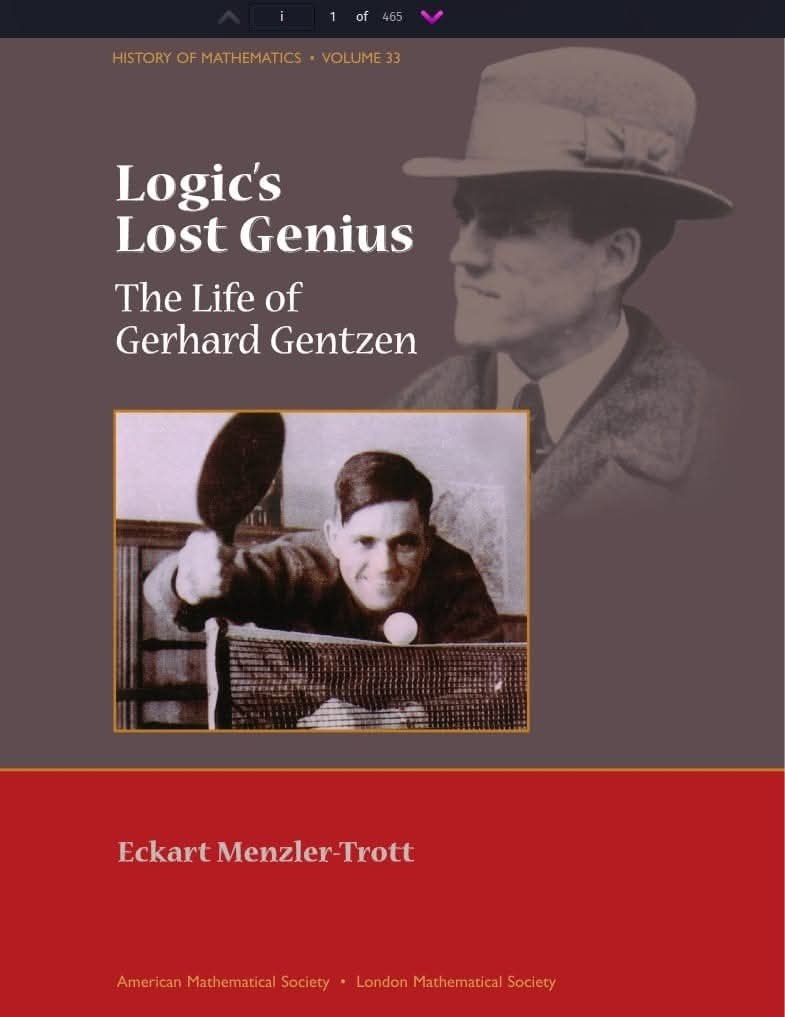
332. Eckart Menzler-Trott, *Logic's Lost Genius: The Life of Gerhard Gentzen* (Providence: AMS/London Mathematical Society, 2007).
333. Wolfram Pohlers, *Proof Theory: The First Step into Impredicativity* (Berlin: Springer, 2009).
334. Georg Kreisel, "A Survey of Proof Theory," *Journal of Symbolic Logic* 33 (1968): 321–388.
335. Robert I. Soare, *Computability Theory and Applications* (Berlin: Springer, 2016).
336. Martin Davis, "Why Gödel Didn't Have Church's Thesis," *Information and Control* 54 (1982): 3–24.
337. Alonzo Church, "An Unsolvable Problem of Elementary Number Theory," *American Journal of Mathematics* 58 (1936): 345–363.
338. Alan Turing, "On Computable Numbers, with an Application to the Entscheidungsproblem," *Proceedings of the London Mathematical Society* 42 (1936): 230–265.
339. Douglas Hofstadter, *Gödel, Escher, Bach: An Eternal Golden Braid* (New York: Basic Books, 1979).
340. Jon Barwise and John Etchemendy, *The Liar: An Essay on Truth and Circularity* (Oxford: Oxford University Press, 1987).
341. David Hilbert, "Axiomatisches Denken," *Mathematische Annalen* 78 (1918): 405–415.
342. Stephen Cole Kleene, *Introduction to Metamathematics* (Amsterdam: North-Holland, 1952).
343. Dag Prawitz, *Natural Deduction: A Proof-Theoretical Study* (Stockholm: Almqvist & Wiksell, 1965).
344. Peter Schroeder-Heister, "Proof-Theoretic Semantics," *Stanford Encyclopedia of Philosophy* (2012).
345. Dag Prawitz, "Proofs and the Meaning and Completeness of the Logical Constants," in *Essays on Mathematical and Philosophical Logic*, ed. Jaakko Hintikka et al. (Dordrecht: Reidel, 1979), pp. 25–40.
346. A. S. Troelstra and H. Schwichtenberg, *Basic Proof Theory*, 2nd ed. (Cambridge: Cambridge University Press, 2000).
347. Melvin Fitting, *First-Order Logic and Automated Theorem Proving*, 2nd ed. (New York: Springer, 1996).
348. Jean-Yves Girard, "Linear Logic," *Theoretical Computer Science* 50 (1987): 1–102.
349. Michael Rathjen, "The Art of Ordinal Analysis," in *Proceedings of the International Congress of Mathematicians, Madrid, 2006*, vol. 2, pp. 45–69.
350. Francesco Paoli, *Substructural Logics: A Primer* (Dordrecht: Springer, 2002).
351. Greg Restall, *An Introduction to Substructural Logics* (London: Routledge, 2000).
352. Alan Ross Anderson and Nuel D. Belnap, *Entailment: The Logic of Relevance and Necessity*, vol. 1 (Princeton: Princeton University Press, 1975).
353. Joachim Lambek, "The Mathematics of Sentence Structure," *American Mathematical Monthly* 65 (1958): 154–170.
354. Kosta Došen and Peter Schroeder-Heister, eds., *Substructural Logics* (Oxford: Oxford University Press, 1993).
355. Elia Zardini, "Substructural Approaches to Paradox: An Introduction," *Synthese* 199 (2021): 493–525.
356. Pablo Cobreros, Paul Egré, David Ripley, and Robert van Rooij, "Tolerant, Classical, Strict," *Journal of Philosophical Logic* 41 (2012): 347–385.
357. Ingebrigt Johansson, "Der Minimalkalkül, ein reduzierter intuitionistischer Formalismus," *Compositio Mathematica* 4 (1937): 119–136.
358. Solomon Feferman, "Highlights in Proof Theory," in *Proof, Logic and Formalization*, ed. Michael Detlefsen (London: Routledge, 1992), pp. 11–26.
359. Dag Prawitz, "Philosophical Aspects of Proof Theory," in *Contemporary Philosophy*, vol. 1, ed. Guttorm Fløistad (The Hague: Martinus Nijhoff, 1981), pp. 235–277.
360. Haskell Curry, "Functionality in Combinatory Logic," *Proceedings of the National Academy of Sciences* 20 (1934): 584–590.
361. William A. Howard, "The Formulae-as-Types Notion of Construction" (1969), in J. P. Seldin and J. R. Hindley, eds., *To H. B. Curry: Essays on Combinatory Logic, Lambda Calculus and Formalism* (London: Academic Press, 1980), pp. 479–490.